How to Test Pricing and Packaging
Use survey experiments or conjoint analysis to study reactions to prices, bundles, and feature packages.
The Short Version
Use survey experiments or conjoint analysis to study reactions to prices, bundles, and feature packages. A practical way to begin is to decide whether the question concerns one complete offer or tradeoffs among several features, then use a survey experiment when respondents should see one randomized offer and report an outcome. Finish by making sure you validate consequential pricing decisions with behavioral or market data when possible. The full walkthrough below explains each part in order.
Is This Guide for You?
Product, marketing, and strategy teams exploring which offer configurations customers prefer.
Follow These Steps
Work through these 7 steps at your own pace. The wording is intentionally practical, and you can return to the checklist at the end when you are ready to review your work.
- Decide whether the question concerns one complete offer or tradeoffs among several features.
- Use a survey experiment when respondents should see one randomized offer and report an outcome.
- Use conjoint when respondents should repeatedly choose among offers with independently varying price, features, or terms.
- Choose realistic price levels and packages that the business could actually offer.
- Add restrictions for combinations that cannot exist.
- Measure choice or purchase intention and include uncertainty in the analysis.
- Validate consequential pricing decisions with behavioral or market data when possible.
What This Helps You Accomplish
Survey experiments estimate reactions to complete offers, while conjoint studies estimate tradeoffs among offer attributes. Choosing the design that matches the decision avoids forcing a complex pricing question into a simple preference poll.
What a Good Result Looks Like
A pricing and packaging study should identify which combinations of price, features, support, and contract terms change preference within a plausible buying context. It should narrow decisions, not promise exact revenue.
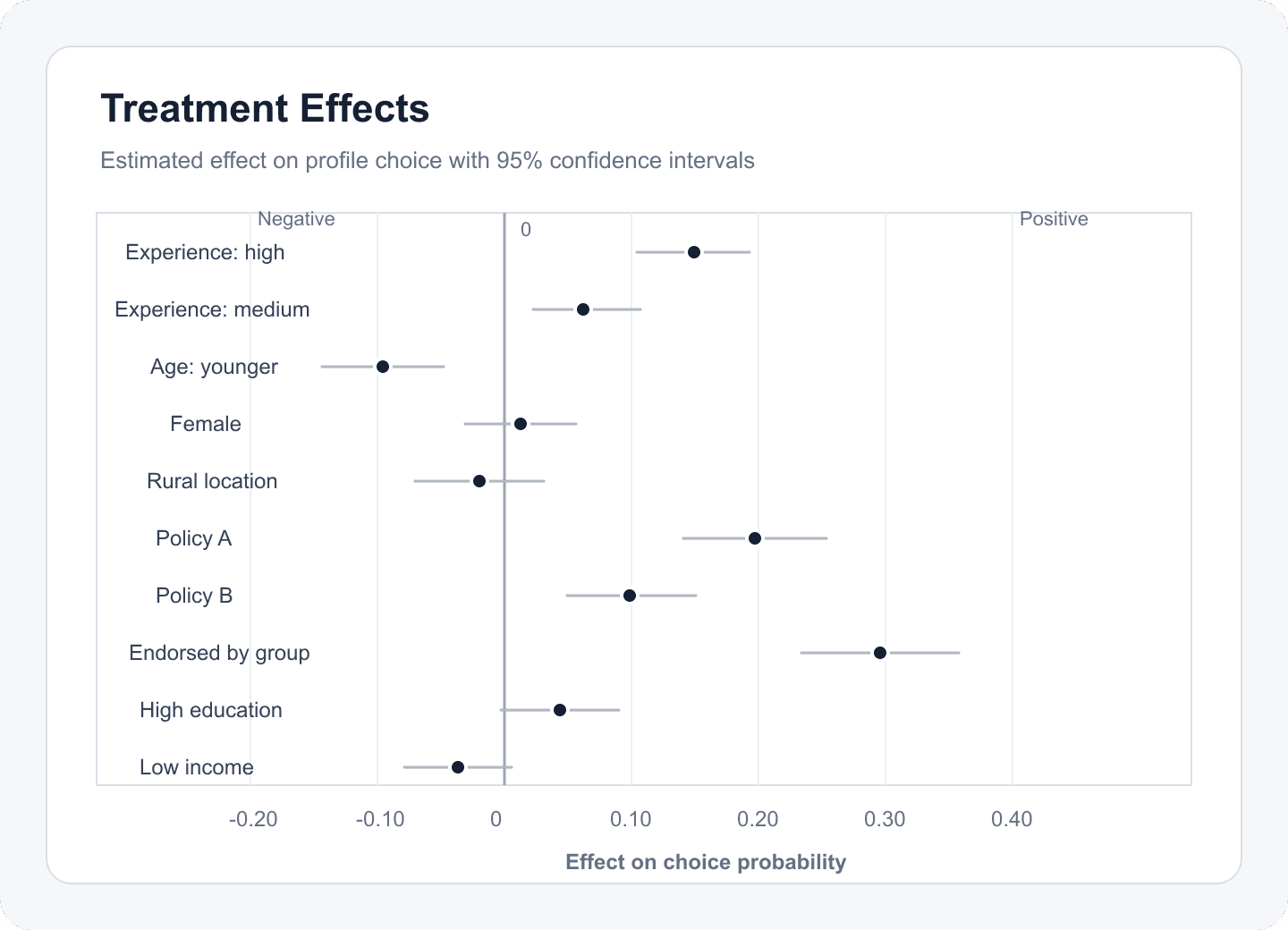
Example: compare package architecture
Test monthly price at $25, $50, and $75 alongside support and contract attributes. If the $75 penalty is much larger than the benefit of phone support, the team learns that premium support alone may not justify the highest tier. Cost and operational feasibility still belong in the final decision model.
Decisions to Make Before You Begin
- Define the customer segment and purchase context.
- Use prices that could genuinely be offered.
- Decide whether to test individual features or named bundles.
- Plan how preference evidence will be combined with margin and cost data.
Common Mistakes to Avoid
- Using implausibly low anchors to make the preferred package look attractive.
- Presenting conjoint choices as guaranteed willingness to pay.
- Ignoring the current market alternatives customers actually face.
Your Practical Next Step
Open the populated software package example and replace its three attributes with the exact choices facing your pricing team.
A Quick Confidence Check
- Match the method to the decision.
- Use plausible offers.
- Avoid implausible feature-price combinations.
- Do not interpret stated intention as guaranteed demand.
- Pilot comprehension.
- Use market evidence before a major rollout.
Common Questions
Can I use this guide if I am new to this?
Yes. Product, marketing, and strategy teams exploring which offer configurations customers prefer. Follow the steps in order, start with a small test, and use the final checklist before you field or report anything important.
What is the simplest way to get started?
Begin by decide whether the question concerns one complete offer or tradeoffs among several features. Next, use a survey experiment when respondents should see one randomized offer and report an outcome. You do not need to perfect every setting before running a small preview or pilot.
How do I know when I am ready?
Use the confidence check above. In particular: Match the method to the decision. Use plausible offers. Avoid implausible feature-price combinations. Do not interpret stated intention as guaranteed demand. When the decision is consequential, keep your study documentation and ask a qualified colleague or methods reviewer to examine the design as well.
Related Guides
Research artifact: sample data, codebook, and scriptsResearch Pathways
Product names and fielding platforms mentioned in this guide belong to their respective owners. Conjoint Survey is an independent academic research tool and is not affiliated with, sponsored by, or endorsed by those services.