How to Use Free Conjoint Analysis Software for a Pilot Study
Build, publish, and test a free conjoint analysis pilot before paying for full fielding and data exports.
The Short Version
Build, publish, and test a free conjoint analysis pilot before paying for full fielding and data exports. A practical way to begin is to create a free account and build one pilot survey, then enter the attributes, levels, restrictions, questions, and respondent instructions. Finish by making sure you revise the design before upgrading for full exports and larger fielding. The full walkthrough below explains each part in order.
Is This Guide for You?
Researchers who want to confirm that a conjoint design works before committing software or respondent money.
Follow These Steps
Work through these 6 steps at your own pace. The wording is intentionally practical, and you can return to the checklist at the end when you are ready to review your work.
- Create a free account and build one pilot survey.
- Enter the attributes, levels, restrictions, questions, and respondent instructions.
- Preview the complete survey on desktop and mobile.
- Publish the pilot and collect up to 20 completed responses.
- Inspect the in-app results and editable graphs.
- Revise the design before upgrading for full exports and larger fielding.
What This Helps You Accomplish
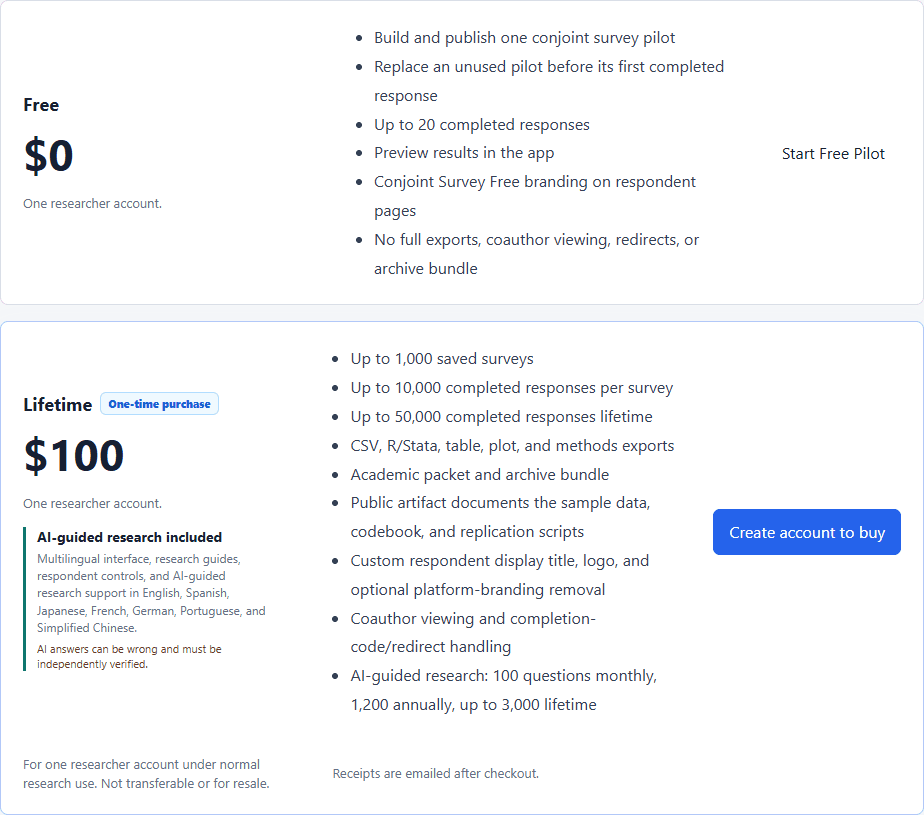
A useful free conjoint pilot should test the real workflow rather than display a restricted demo. Conjoint Survey currently supports one published pilot with up to 20 completed responses and in-app results before purchase.
What a Good Result Looks Like
A valuable free pilot lets the researcher build the real instrument, publish it, collect enough test responses to expose problems, and inspect the intended results. It should help decide whether the study is ready, not encourage conclusions from a tiny convenience sample.
Example: use 20 responses wisely
Recruit a mix of colleagues and target-audience testers. Ask some to comment on wording and let others complete the survey naturally. Inspect timing, mobile display, restrictions, profile balance, respondent paths, and early outputs. Do not choose attributes or hypotheses based on whichever estimate looks strongest in 20 responses.
Decisions to Make Before You Begin
- Define pilot success criteria before collecting responses.
- Decide which testers resemble the target population.
- Record every wording and design revision.
- Keep pilot and main-study data separate when the instrument changes.
Common Mistakes to Avoid
- Calling a free pilot the final study.
- Using all responses before testing the link and export.
- Upgrading or recruiting broadly before resolving obvious confusion.
Your Practical Next Step
Build the complete instrument first, then spend the free responses on deliberate tests of the decisions most likely to fail during real fielding.
A Quick Confidence Check
- Test the actual respondent link.
- Use realistic attributes.
- Check mobile layout.
- Inspect profile randomization.
- Do not treat 20 pilot responses as a final powered study.
Common Questions
Can I use this guide if I am new to this?
Yes. Researchers who want to confirm that a conjoint design works before committing software or respondent money. Follow the steps in order, start with a small test, and use the final checklist before you field or report anything important.
What is the simplest way to get started?
Begin by create a free account and build one pilot survey. Next, enter the attributes, levels, restrictions, questions, and respondent instructions. You do not need to perfect every setting before running a small preview or pilot.
How do I know when I am ready?
Use the confidence check above. In particular: Test the actual respondent link. Use realistic attributes. Check mobile layout. Inspect profile randomization. When the decision is consequential, keep your study documentation and ask a qualified colleague or methods reviewer to examine the design as well.
Related Guides
Research artifact: sample data, codebook, and scriptsResearch Pathways
Product names and fielding platforms mentioned in this guide belong to their respective owners. Conjoint Survey is an independent academic research tool and is not affiliated with, sponsored by, or endorsed by those services.