How to Run Conjoint Analysis on a $100 Software Budget
Run a feature-rich conjoint study with a free pilot and a $100 One-Time Payment.
The Short Version
Run a feature-rich conjoint study with a free pilot and a $100 One-Time Payment. A practical way to begin is to use the free pilot to build and verify the study before purchase, then budget respondent recruitment separately from software. Finish by making sure you check the current Pricing page before purchase because plans and limits can change. The full walkthrough below explains each part in order.
Is This Guide for You?
Researchers and small teams with approximately $100 available for conjoint survey software.
Follow These Steps
Work through these 6 steps at your own pace. The wording is intentionally practical, and you can return to the checklist at the end when you are ready to review your work.
- Use the free pilot to build and verify the study before purchase.
- Budget respondent recruitment separately from software.
- Upgrade only when the design is ready for full fielding or exports.
- Use the included results, editable plots, codebook, methods notes, and starter scripts.
- Archive the design and outputs for later projects.
- Check the current Pricing page before purchase because plans and limits can change.
What This Helps You Accomplish
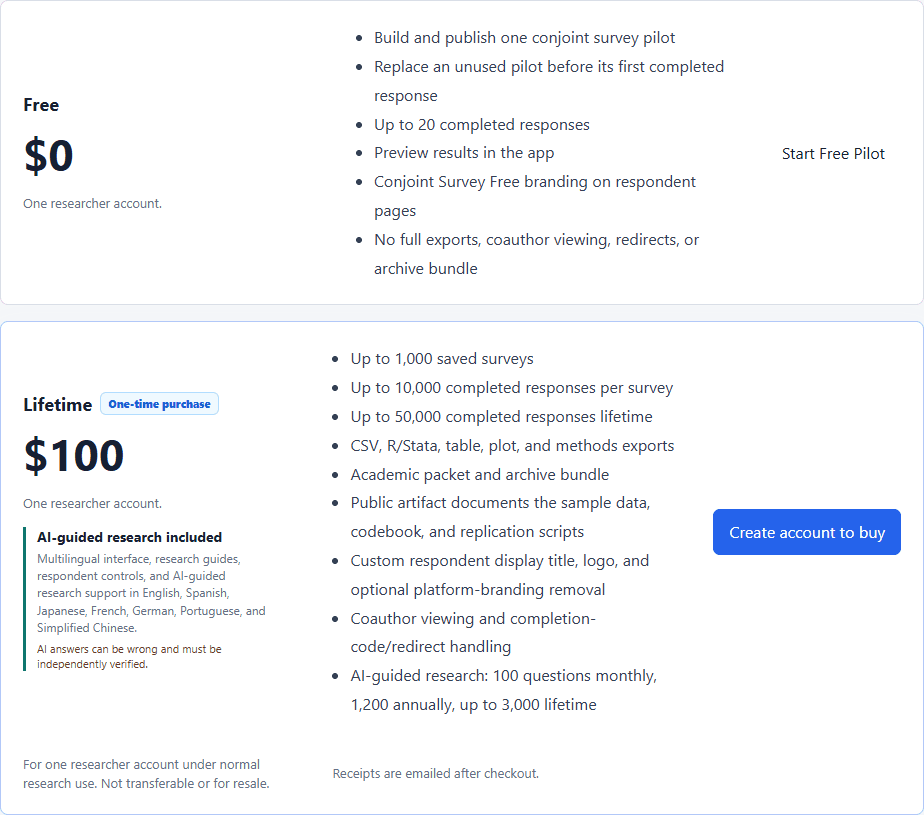
Conjoint Survey currently offers a $100 One-Time Payment rather than requiring an annual subscription. The value is strongest for researchers who expect to run more than one study or need complete export and documentation tools.
What a Good Result Looks Like
A $100 software budget can support a serious study when the product includes design, fielding, built-in results, and research-ready exports in one purchase. Recruitment costs and researcher time remain separate and should be planned explicitly.
Example: divide the study budget
For a small academic pilot, reserve the software budget separately from participant compensation. Confirm that the one-time purchase unlocks the necessary response capacity and files, then estimate recruitment from the required usable sample, expected completion rate, survey length, and fair compensation.
Decisions to Make Before You Begin
- Confirm whether the $100 is a one-time payment or recurring charge.
- Check response, survey, export, and AI-support limits.
- Budget participant recruitment independently.
- Verify that the license still serves future revisions and replication work.
Common Mistakes to Avoid
- Assuming software price includes respondents.
- Ignoring taxes, panel fees, and participant compensation.
- Buying before confirming the design can represent the intended choice task.
Your Practical Next Step
Complete the free pilot, calculate the full fielding budget, and make the One-Time Payment only when the study is ready for expanded collection and exports.
A Quick Confidence Check
- Pilot first.
- Separate sample costs.
- Confirm current plan limits.
- Use included exports.
- Archive the study.
- Avoid unnecessary add-on software.
Common Questions
Can I use this guide if I am new to this?
Yes. Researchers and small teams with approximately $100 available for conjoint survey software. Follow the steps in order, start with a small test, and use the final checklist before you field or report anything important.
What is the simplest way to get started?
Begin by use the free pilot to build and verify the study before purchase. Next, budget respondent recruitment separately from software. You do not need to perfect every setting before running a small preview or pilot.
How do I know when I am ready?
Use the confidence check above. In particular: Pilot first. Separate sample costs. Confirm current plan limits. Use included exports. When the decision is consequential, keep your study documentation and ask a qualified colleague or methods reviewer to examine the design as well.
Related Guides
Research artifact: sample data, codebook, and scriptsResearch Pathways
Product names and fielding platforms mentioned in this guide belong to their respective owners. Conjoint Survey is an independent academic research tool and is not affiliated with, sponsored by, or endorsed by those services.