How to Test Product Feature Priorities
Measure which product capabilities matter most when customers must make realistic tradeoffs.
The Short Version
Measure which product capabilities matter most when customers must make realistic tradeoffs. A practical way to begin is to list features that could realistically vary, then convert each feature into clear levels. Finish by making sure you compare feature-level effects and uncertainty before making roadmap decisions. The full walkthrough below explains each part in order.
Is This Guide for You?
Product teams prioritizing roadmap investments across competing customer needs.
Follow These Steps
Work through these 6 steps at your own pace. The wording is intentionally practical, and you can return to the checklist at the end when you are ready to review your work.
- List features that could realistically vary.
- Convert each feature into clear levels.
- Include price or another cost when tradeoffs require it.
- Add restrictions for impossible combinations.
- Run conjoint choice tasks with the target audience.
- Compare feature-level effects and uncertainty before making roadmap decisions.
What This Helps You Accomplish
Simple importance ratings let customers call every feature essential. Conjoint choices force tradeoffs and better reveal which differences change preference.
What a Good Result Looks Like
A strong feature-priority study forces realistic tradeoffs and produces evidence the roadmap team can combine with engineering effort, strategy, and customer need. It avoids the familiar survey result in which every feature is rated important.
Example: prioritize three roadmap investments
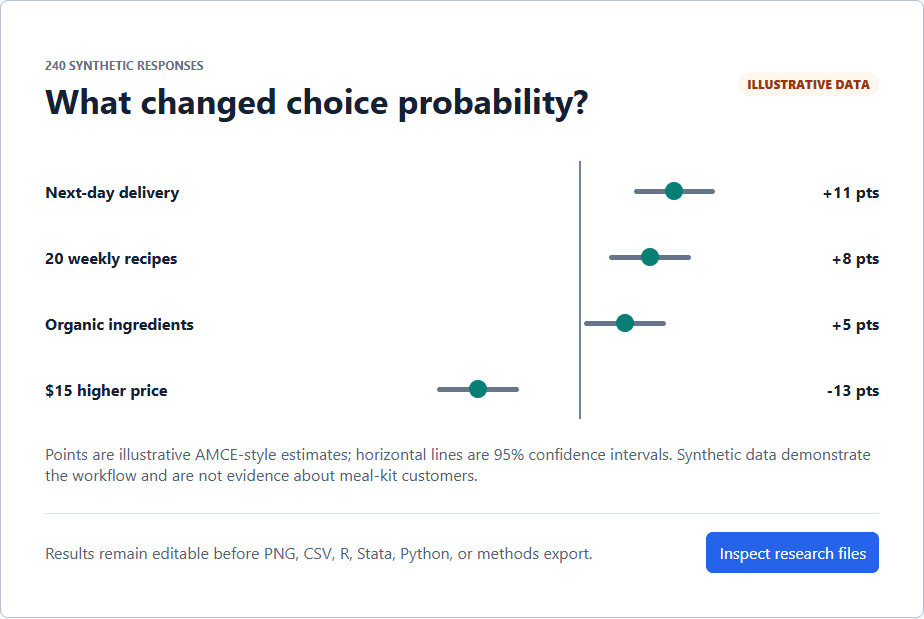
A team choosing among faster exports, collaboration, and automated reporting can describe each capability with concrete levels and include price or delivery time as a cost. Randomized choices reveal which improvements actually change preference when respondents cannot select everything.
Decisions to Make Before You Begin
- Choose features that compete for the same roadmap resources.
- Translate internal feature names into customer-visible outcomes.
- Include a cost, delay, or other realistic tradeoff.
- Define how preference, effort, risk, and strategy will be combined.
Common Mistakes to Avoid
- Testing features that respondents cannot understand without a demo.
- Treating average preference as unanimity across customer segments.
- Selecting a roadmap solely from coefficient rank order.
Your Practical Next Step
List the next three roadmap decisions, not the entire backlog. Build levels around those decisions and pilot the wording with actual target users.
A Quick Confidence Check
- Use understandable feature levels.
- Limit attributes.
- Include realistic constraints.
- Sample target users.
- Do not treat aggregate preference as a promise from every customer.
Common Questions
Can I use this guide if I am new to this?
Yes. Product teams prioritizing roadmap investments across competing customer needs. Follow the steps in order, start with a small test, and use the final checklist before you field or report anything important.
What is the simplest way to get started?
Begin by list features that could realistically vary. Next, convert each feature into clear levels. You do not need to perfect every setting before running a small preview or pilot.
How do I know when I am ready?
Use the confidence check above. In particular: Use understandable feature levels. Limit attributes. Include realistic constraints. Sample target users. When the decision is consequential, keep your study documentation and ask a qualified colleague or methods reviewer to examine the design as well.
Related Guides
Research artifact: sample data, codebook, and scriptsResearch Pathways
Product names and fielding platforms mentioned in this guide belong to their respective owners. Conjoint Survey is an independent academic research tool and is not affiliated with, sponsored by, or endorsed by those services.