How to Measure Willingness to Pay
Use price experiments and conjoint tradeoffs to estimate how stated preference changes across prices.
The Short Version
Use price experiments and conjoint tradeoffs to estimate how stated preference changes across prices. A practical way to begin is to define the product and purchasing context, then choose plausible price levels. Finish by making sure you validate important pricing decisions with transactions or a live market test. The full walkthrough below explains each part in order.
Is This Guide for You?
Pricing, product, and strategy teams exploring a plausible price range before market validation.
Follow These Steps
Work through these 6 steps at your own pace. The wording is intentionally practical, and you can return to the checklist at the end when you are ready to review your work.
- Define the product and purchasing context.
- Choose plausible price levels.
- Include competing product features or packages when they affect value.
- Randomize prices or use price as a conjoint attribute.
- Estimate how preference changes relative to the reference price.
- Validate important pricing decisions with transactions or a live market test.
What This Helps You Accomplish
Survey evidence can reveal price sensitivity, but hypothetical answers are not guaranteed purchases. Responsible willingness-to-pay work combines stated tradeoffs with behavioral validation.
What a Good Result Looks Like
Responsible willingness-to-pay research estimates how stated choices change across credible prices and reports uncertainty and assumptions. It provides a range for further testing rather than a magical single price customers are guaranteed to pay.
Example: interpret price sensitivity cautiously
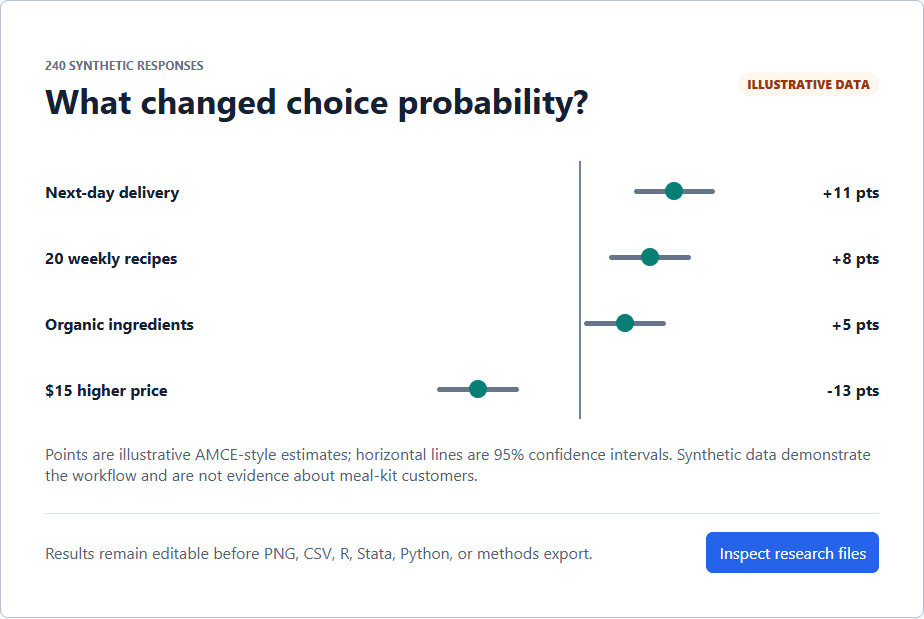
If preference falls 8 percentage points from $25 to $50 and 19 points from $25 to $75, the evidence shows increasing resistance across the tested range. It does not establish that $25 maximizes revenue. The business must combine the demand pattern with costs, conversion behavior, and the value of other package features.
Decisions to Make Before You Begin
- Define whether the decision concerns a price point, package, or discount.
- Choose a credible range without extreme anchors.
- Include the features that create value alongside price.
- Plan a behavioral validation such as a live offer or transaction test.
Common Mistakes to Avoid
- Asking only what people say they would pay.
- Extrapolating beyond the tested price range.
- Ignoring hypothetical bias and sample composition.
Your Practical Next Step
Use price as a conjoint attribute, report level contrasts and intervals, and describe the result as stated preference until behavior confirms it.
A Quick Confidence Check
- Use credible prices.
- Avoid leading price anchors.
- Describe the offer consistently.
- Report uncertainty.
- Do not present stated preference as forecast revenue.
Common Questions
Can I use this guide if I am new to this?
Yes. Pricing, product, and strategy teams exploring a plausible price range before market validation. Follow the steps in order, start with a small test, and use the final checklist before you field or report anything important.
What is the simplest way to get started?
Begin by define the product and purchasing context. Next, choose plausible price levels. You do not need to perfect every setting before running a small preview or pilot.
How do I know when I am ready?
Use the confidence check above. In particular: Use credible prices. Avoid leading price anchors. Describe the offer consistently. Report uncertainty. When the decision is consequential, keep your study documentation and ask a qualified colleague or methods reviewer to examine the design as well.
Related Guides
Research artifact: sample data, codebook, and scriptsResearch Pathways
Product names and fielding platforms mentioned in this guide belong to their respective owners. Conjoint Survey is an independent academic research tool and is not affiliated with, sponsored by, or endorsed by those services.