How to Choose Affordable Conjoint Survey Software
Evaluate lower-cost conjoint tools without giving up randomization records, exports, or documentation.
The Short Version
Evaluate lower-cost conjoint tools without giving up randomization records, exports, or documentation. A practical way to begin is to start with the scientific requirements: randomized attributes, stored profiles, respondent IDs, and analyzable exports, then check whether the tool supports restrictions for impossible profiles. Finish by making sure you pilot the full workflow before spending money on a sample. The full walkthrough below explains each part in order.
Is This Guide for You?
Researchers who need a real conjoint study but do not have enterprise software access or a large methods budget.
Follow These Steps
Work through these 5 steps at your own pace. The wording is intentionally practical, and you can return to the checklist at the end when you are ready to review your work.
- Start with the scientific requirements: randomized attributes, stored profiles, respondent IDs, and analyzable exports.
- Check whether the tool supports restrictions for impossible profiles.
- Confirm that it exports profile-level long data for AMCE/ATE analysis.
- Look for design review, randomization audit, balance diagnostics, and methods documentation.
- Pilot the full workflow before spending money on a sample.
What This Helps You Accomplish
Low cost is only useful if the data remain defensible. The goal is not the lowest-price form builder; the goal is affordable software that still produces transparent randomization, clean exports, and documentation that helps researchers answer reviewer questions.
What a Good Result Looks Like
The right low-cost tool reduces expense without hiding randomization records, quality checks, or analysis data. A serious comparison asks what the researcher can build, verify, field, and export, not merely whether a page contains the word conjoint.
Example: create a requirements scorecard
Score each candidate tool on profile randomization, impossible-combination rules, respondent links, mobile preview, response caps, AMCE-style results, editable figures, codebooks, and analysis scripts. Mark every item as tested, documented, or unknown. Unknown capabilities are risks, not assumed features.
Decisions to Make Before You Begin
- Set a total budget including software, recruitment, and analysis time.
- Identify the features required for the intended publication or decision.
- Check whether access ends with a subscription.
- Confirm how data can be recovered if the project pauses.
Common Mistakes to Avoid
- Choosing the lowest sticker price without testing exports.
- Confusing a choice question with a randomized conjoint design.
- Ignoring the labor cost of reconstructing missing documentation.
Your Practical Next Step
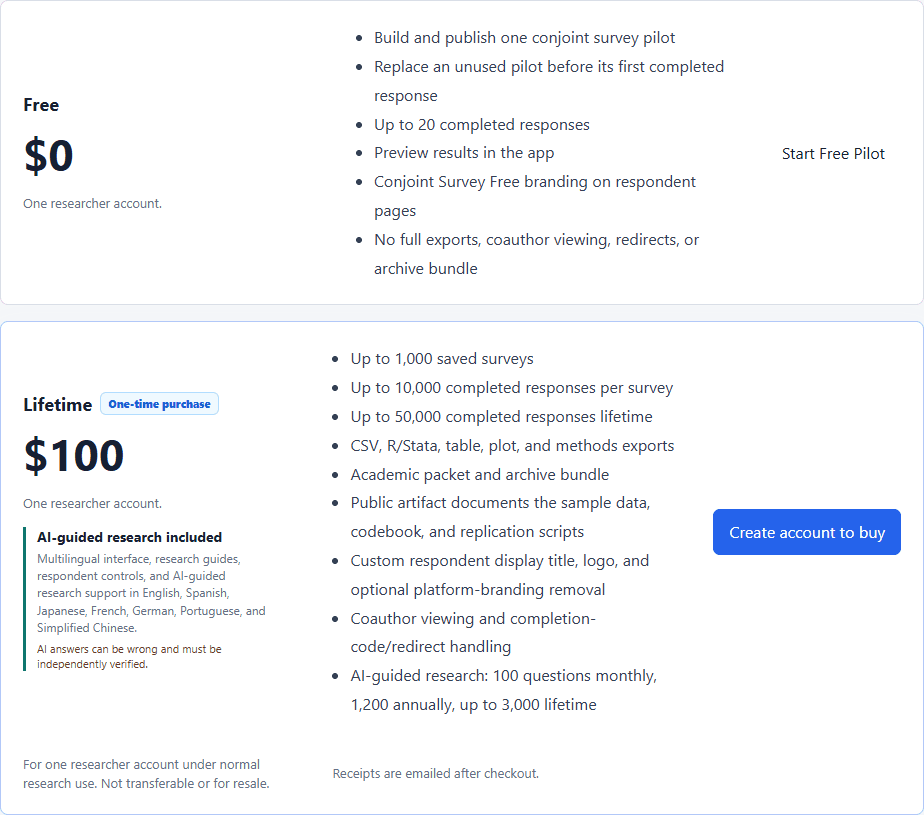
Use the free pilot to run one complete respondent and export review. A tool that cannot pass that small test is not inexpensive at any price.
A Quick Confidence Check
- Avoid tools that only export respondent-level summaries for conjoint choices.
- Make sure you can recover exactly what each respondent saw.
- Check whether full exports are gated behind a plan you can afford.
- Prefer tools with validation or methodology documentation.
Common Questions
Can I use this guide if I am new to this?
Yes. Researchers who need a real conjoint study but do not have enterprise software access or a large methods budget. Follow the steps in order, start with a small test, and use the final checklist before you field or report anything important.
What is the simplest way to get started?
Begin by start with the scientific requirements: randomized attributes, stored profiles, respondent IDs, and analyzable exports. Next, check whether the tool supports restrictions for impossible profiles. You do not need to perfect every setting before running a small preview or pilot.
How do I know when I am ready?
Use the confidence check above. In particular: Avoid tools that only export respondent-level summaries for conjoint choices. Make sure you can recover exactly what each respondent saw. Check whether full exports are gated behind a plan you can afford. Prefer tools with validation or methodology documentation. When the decision is consequential, keep your study documentation and ask a qualified colleague or methods reviewer to examine the design as well.
Related Guides
Research artifact: sample data, codebook, and scriptsResearch Pathways
Product names and fielding platforms mentioned in this guide belong to their respective owners. Conjoint Survey is an independent academic research tool and is not affiliated with, sponsored by, or endorsed by those services.