How to Write Conjoint Attributes and Levels
Write attribute names and levels that respondents can understand and analysts can defend.
The Short Version
Write attribute names and levels that respondents can understand and analysts can defend. A practical way to begin is to name each attribute in plain language, then write levels that are mutually exclusive within an attribute. Finish by making sure you run a pilot and revise confusing labels. The full walkthrough below explains each part in order.
Is This Guide for You?
Researchers building candidate, policy, product, hiring, housing, or health conjoint designs.
Follow These Steps
Work through these 6 steps at your own pace. The wording is intentionally practical, and you can return to the checklist at the end when you are ready to review your work.
- Name each attribute in plain language.
- Write levels that are mutually exclusive within an attribute.
- Keep level wording parallel where possible.
- Avoid mixing multiple concepts into one level.
- Confirm each level is plausible in the field context.
- Run a pilot and revise confusing labels.
What This Helps You Accomplish
Respondents react to the words shown on the profile. Clean attribute and level wording improves interpretation and reduces reviewer questions about what the estimates mean.
What a Good Result Looks Like
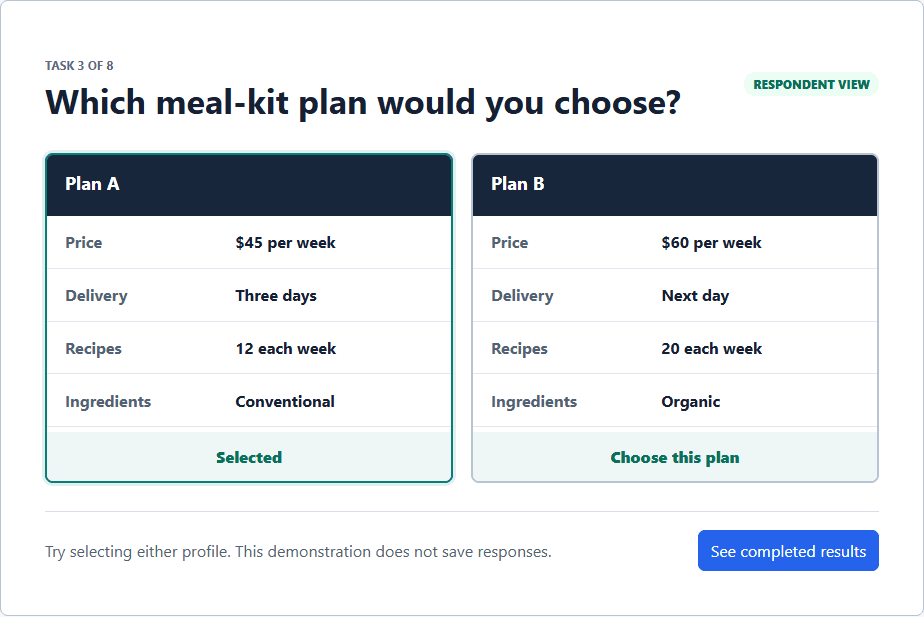
Strong attributes describe distinct dimensions of an alternative, while levels describe concrete versions of each dimension. Respondents should be able to scan a profile and understand every row without needing definitions, and the resulting contrasts should map to decisions you could actually make.
Example: improve a vague feature list
Instead of an attribute called Quality with levels Low, Medium, and High, use a measurable feature such as Response time with levels Within 24 hours, Within 4 hours, and Within 30 minutes. The revised wording tells respondents what changes and gives the research team a comparison it can interpret and potentially deliver.
Decisions to Make Before You Begin
- Decide whether each attribute represents one idea rather than several bundled ideas.
- Choose a reference level that creates a meaningful comparison.
- Use level wording that is mutually exclusive and similar in grammatical form.
- Add restrictions only when combinations are truly impossible, not merely undesirable.
Common Mistakes to Avoid
- Mixing a feature and its benefit in the same attribute.
- Using labels such as basic or premium without explaining what they contain.
- Including one implausibly attractive level that makes the choice task trivial.
Your Practical Next Step
Read every profile aloud as a complete alternative. If a row sounds ambiguous or requires explanation, rewrite it before fielding.
A Quick Confidence Check
- Use short labels.
- Avoid jargon unless the sample expects it.
- Do not hide treatments inside vague labels.
- Document any wording changes after pilot testing.
Common Questions
Can I use this guide if I am new to this?
Yes. Researchers building candidate, policy, product, hiring, housing, or health conjoint designs. Follow the steps in order, start with a small test, and use the final checklist before you field or report anything important.
What is the simplest way to get started?
Begin by name each attribute in plain language. Next, write levels that are mutually exclusive within an attribute. You do not need to perfect every setting before running a small preview or pilot.
How do I know when I am ready?
Use the confidence check above. In particular: Use short labels. Avoid jargon unless the sample expects it. Do not hide treatments inside vague labels. Document any wording changes after pilot testing. When the decision is consequential, keep your study documentation and ask a qualified colleague or methods reviewer to examine the design as well.
Related Guides
Research artifact: sample data, codebook, and scriptsResearch Pathways
Product names and fielding platforms mentioned in this guide belong to their respective owners. Conjoint Survey is an independent academic research tool and is not affiliated with, sponsored by, or endorsed by those services.