How to Choose Conjoint Survey Software for Dissertation Research
A practical workflow for graduate students who need a defensible conjoint study without enterprise procurement.
The Short Version
A practical workflow for graduate students who need a defensible conjoint study without enterprise procurement. A practical way to begin is to translate the dissertation theory into attributes and levels, then write clear respondent instructions and consent language. Finish by making sure you export the long-format data, methods text, codebook, and appendix materials for the dissertation. The full walkthrough below explains each part in order.
Is This Guide for You?
PhD students and dissertation researchers building conjoint experiments with limited time, limited budget, and committee scrutiny.
Follow These Steps
Work through these 6 steps at your own pace. The wording is intentionally practical, and you can return to the checklist at the end when you are ready to review your work.
- Translate the dissertation theory into attributes and levels.
- Write clear respondent instructions and consent language.
- Build a pilot conjoint with a small number of tasks.
- Use Study Review and the randomization audit before fielding.
- Recruit respondents through the approved sample source.
- Export the long-format data, methods text, codebook, and appendix materials for the dissertation.
What This Helps You Accomplish
Dissertation research needs to be affordable, but it also has to satisfy advisors, committees, IRB, and future reviewers. A focused workflow reduces the chance that the student spends weeks programming randomization or cleaning unusable exports.
What a Good Result Looks Like
Dissertation software should help a student move from proposal to defensible evidence without creating a fragile custom system. The design, instrument, randomization, exclusions, codebook, and analysis path should be understandable to an adviser and reproducible later.
Example: prepare for the proposal meeting
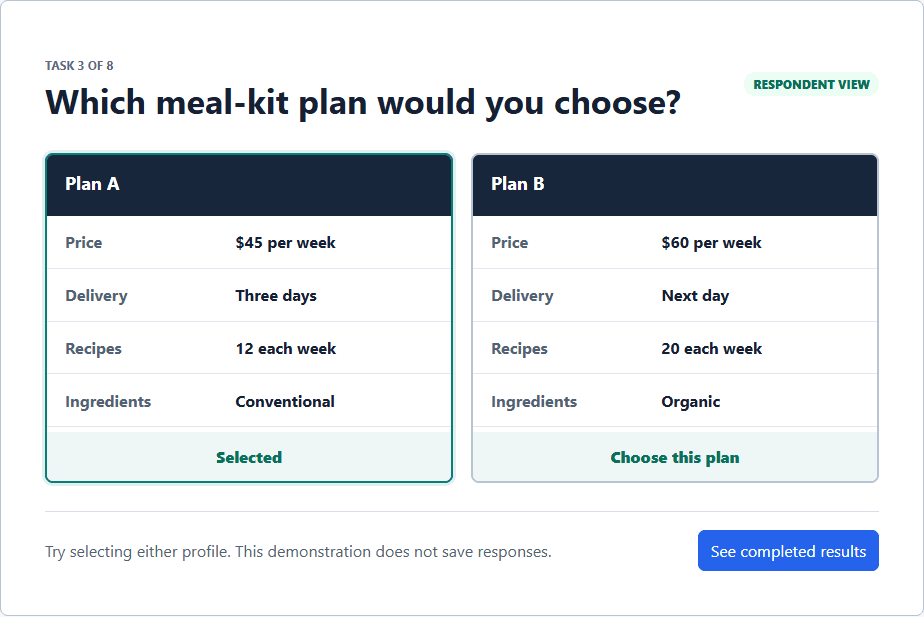
Build a small version with three attributes and six to eight tasks, add draft consent and outcomes, then print or export the instrument for adviser review. Use synthetic or pilot responses to demonstrate the output structure. This turns an abstract methods discussion into a concrete design the committee can critique before recruitment begins.
Decisions to Make Before You Begin
- Connect every attribute to the dissertation's theoretical question.
- Separate pilot, exploratory, and confirmatory analyses.
- Plan sample size, exclusions, and clustering before fielding.
- Confirm IRB, data retention, and recruitment requirements with the institution.
Common Mistakes to Avoid
- Choosing software after the proposal promises features it cannot support.
- Treating automatic output as a substitute for understanding the estimand.
- Waiting until final analysis to inspect profile-level data and codebooks.
Your Practical Next Step
Open the dissertation starter, replace the placeholder theory and attributes, and bring the printed design plus one sample output to the next methods discussion.
A Quick Confidence Check
- Keep the design simple enough for respondents to understand.
- Ask advisors to review the design summary before fielding.
- Preregister if appropriate for the field.
- Save the replication bundle with the dissertation materials.
Common Questions
Can I use this guide if I am new to this?
Yes. PhD students and dissertation researchers building conjoint experiments with limited time, limited budget, and committee scrutiny. Follow the steps in order, start with a small test, and use the final checklist before you field or report anything important.
What is the simplest way to get started?
Begin by translate the dissertation theory into attributes and levels. Next, write clear respondent instructions and consent language. You do not need to perfect every setting before running a small preview or pilot.
How do I know when I am ready?
Use the confidence check above. In particular: Keep the design simple enough for respondents to understand. Ask advisors to review the design summary before fielding. Preregister if appropriate for the field. Save the replication bundle with the dissertation materials. When the decision is consequential, keep your study documentation and ask a qualified colleague or methods reviewer to examine the design as well.
Related Guides
Research artifact: sample data, codebook, and scriptsResearch Pathways
Product names and fielding platforms mentioned in this guide belong to their respective owners. Conjoint Survey is an independent academic research tool and is not affiliated with, sponsored by, or endorsed by those services.